Flourishing Performance Indicators: A New Framework for Wealth and Legacy

An estimated $84 trillion will pass from one generation to the next by 2045. For families of significant wealth, this moment presents both extraordinary opportunity and risk. This article introduces a new paradigm for evaluating long-term family success through Flourishing Performance Indicators (FPIs).
“The biggest risk to wealth isn’t a poor investment or bad tax strategy. The biggest risk to wealth is dysfunction within the family itself.”
Executive Summary
The greatest wealth transfer in human history is happening now — an estimated $84 trillion will pass from one generation to the next by 2045. For families of significant wealth, and for the professionals who advise them, this moment presents both extraordinary opportunity and risk.
The default metrics for a family’s success and legacy remains largely financial: asset preservation, investment returns, tax mitigation, and control. But research indicates that those KPIs (Key Performance Indicators) are not sufficient to measure whether flourishing is happening within the family. In fact, most families of significant wealth struggle to communicate effectively and lack a sense of shared purpose, which often leads to failure of wealth transfer and preservation.
Ironically, the biggest risk to wealth isn’t a poor investment or bad tax strategy. The biggest risk to wealth is dysfunction or poor communication within the family itself.
The Six FPIs:
- Psychological – Mental and emotional well-being
- Physical – Health and wellness
- Purpose – Meaning and direction
- Principles – Character and values
- People – Relationships and belonging
- Prosperity – Financial and material stability
This article introduces a new paradigm for evaluating long-term family success: Flourishing Performance Indicators (FPIs). Sifting through the vast interdisciplinary field of flourishing, and in dialogue with findings from Global Flourishing Study (GFS), the most ambitious global, longitudinal, social science study of flourishing in human history, we extract six key FPIs: Psychological, Physical, Purpose, Principles, People, and Prosperity. These essential indicators, and the FPI framework more generally, invite families to track and cultivate holistic flourishing, not just financial flourishing.
The audience for this piece includes:
- UHNW families seeking a more meaningful definition of legacy
- Legacy-minded business owners, family office executives, wealth managers, estate attorneys, etc.
- Rising-generation inheritors wrestling with identity, purpose, and voice
Ultimately, this piece challenges readers to redefine success. It asks: Are we flourishing as a family or legacy-minded business? And it offers a roadmap for those ready to take the next step.
Are we measuring what matters?
We are living through the greatest wealth transfer in human history. Trillions of dollars are moving from one generation to the next — quietly, inevitably, and often without a map. By some estimates, more than $84 trillion will pass from Baby Boomers to their heirs and philanthropic causes by 2045 (Cerulli Associates 2022). For advisors, families, and institutions alike, this moment represents both tremendous opportunity and hidden risk.
Much of this wealth is concentrated in the hands of business owners — family firms contribute 87% of business tax returns and 54% of private sector GDP — and studies suggest that up to 90% of the wealth these families steward will be lost by the third generation (Williams and Preisser 2003).
We argue that the critical reason for this preventable loss is that families have rarely considered the importance of flourishing for good stewardship of inter-generational wealth and legacy. It is worth noting that an inordinate share of this wealth (perhaps more than 70%) in the next 10 to 15 years will be controlled by widows (Garmhausen 2025) who tend to outlive the founders/leaders of family business and who will likely be more interested in FPIs (Flourishing Performance Indicators) than these founders/leaders. We offer a new framework and practical set of indicators that can expand the scope of business and family conversations immediately.
Our framework and metrics can be easily adapted for use in publicly traded companies as well (VanderWeele and Johnson 2025).
Traditionally, success is measured by one dominant metric: growth and preservation of financial capital. Did the assets grow? Were taxes minimized? Were trusts executed properly? While these are all important questions, they are also incomplete. We’ve grown used to tracking what is measurable, but not necessarily what matters most. In our chase for performance metrics — Key Performance Indicators (KPIs) — we’ve elevated financial dashboards above relational, emotional, and even spiritual health. And it’s not working.
Alarming Statistics
90% of wealthy families lose their wealth by the third generation — not due to poor investing, but because of breakdown in communication, lack of preparation among heirs, and absence of shared purpose.
It is worth repeating: 90% of wealthy families lose their wealth by the third generation (Williams and Preisser 2003). But the culprit is not poor investing. According to research by Roy Williams and Vic Preisser (2003), the primary reasons for this collapse are a breakdown in communication, lack of preparation among heirs, and an absence of shared purpose. In other words, the problem isn’t money. It’s meaning.
In Wealth Management, we often speak about legacy as if it were synonymous with a balance sheet. But inheritance without identity, values, or voice is a fragile gift. The “success” we so often pursue — growing the pie, protecting the capital, diversifying the portfolio — can create deeper fractures if it’s not grounded in a noble shared purpose: human flourishing. It is worth noting that the word “wealth” derives from two Anglo-Saxon words, “we ol,” which originally meant “well-being” rather than only financial wealth (Hughes, Jr. 2024). By connecting with this original, deeper meaning, we see how financial capital relates to more important capitals that tend to be neglected (e.g., spiritual, social, intellectual, and human, see Hughes, Jr. 2025; see also the Appendix).
Financial success is a means to an end, not an end in itself. Flourishing provides a North Star that is appropriate for human beings who are capable of more than mere acquisition (Keyes 2002; Lee 2019; Lee et al. 2021; Lee et al. 2025; Lomas, Pawelski, and VanderWeele et al. 2025; Ritchie-Dunham et al. 2024; Ritchie-Dunham, Granville-Chapman, and Lee 2025; Seligman 2011; VanderWeele 2017). Through the authentic pursuit of flourishing we are able to create, to serve a sacred purpose, and to love (Ritchie-Dunham, Granville-Chapman, and Lee 2025; VanderWeele and Lee 2025).
But when our attention is fixated on a singular performance indicator, we lose focus and become inattentive to ultimate concerns (Lee et al. 2021). It’s no wonder that 9 out of 10 wealthy families lose their assets so quickly. As with families, so with societies: the Global Flourishing Study (GFS), the most ambitious global, longitudinal, social science study of flourishing in human history, revealed that GDP is negatively related to flourishing. Interestingly, middle-income countries outperform high-income countries on the essential flourishing indicators, especially meaning, purpose, and satisfying close social relationships (Lee et al. 2025; VanderWeele et al. 2025). These are the things that make life worth living, and yet legacy conversations rarely address them.
As a result, this article proposes a new lens for evaluating generational success: Flourishing Performance Indicators (FPIs). Inspired by the GFS and the Harvard’s Human Flourishing Program’s “five domains of flourishing” – which are ends in themselves (VanderWeele 2017) – FPIs offer families a richer and more holistic way to measure whether we are truly flourishing. Like KPIs, they invite reflection, tracking, and strategy. But unlike KPIs, FPIs invite deeper reflection: Are we becoming the kind of family we want to be?
The False Security of Financial Metrics
Financial capital is the easiest to track and the most noticeable both inside and outside the family. It reveals itself in statements, valuations, and in day-to-day lifestyle decisions, such as the size of your house, the clothes you wear, the car you drive. This visibility can create a false sense of security — and a dangerous tendency to overvalue what we can see and underinvest in what we cannot.
But wealth is not neutral. It changes the dynamics of relationships, introduces questions of entitlement and identity, and amplifies pre-existing emotional or spiritual dynamics. Especially when inherited, wealth can become a source of anxiety, paralysis, and even quiet alienation — particularly for rising-generation family members who never asked for the influence, responsibility, or expectations that come with it.
Multiple studies now confirm what many have sensed intuitively: beyond a certain point, more money does not equate to more happiness. In fact, in many cases, it correlates with less. Indeed, purpose, connection, and engagement are critical factors that wealth alone cannot buy.
Yet, in the absence of a better framework, many families continue to pursue financial security as a sole indicator of flourishing. But what if we flipped the script? What if flourishing can be defined with real evidence, with wealth becoming a tool to nurture it?
Why Financial KPIs Fall Short
We’ve developed a dangerous blind spot: we struggle to quantify what matters most in families — trust, purpose, unity, wisdom, love. These are the harder-to-measure pillars of generational continuity and, as such, are rarely discussed in quarterly meetings.
For successful individuals and families, KPIs are second nature. They are the heartbeat of business — objective, trackable, and tied to outcomes. Financial metrics abound — ROI, CAGR, MOIC, liquidity ratios — all these metrics allow for decisions to be made with clarity and speed. They give leaders a sense of control in a complex environment.
Thus, it is understandable that families and their advisors often rely on similar indicators when thinking about legacy: investment returns, balance sheets, business valuations, or philanthropic dollars deployed. The problem is not the use of KPIs — the problem is mistaking them as the full picture of flourishing.
Money as a Tool, Not a Telos
In classical Greek, telos refers to the ultimate end or goal of a thing — its true purpose. For a ship, the telos is to sail. For a seed, to grow. In American culture, we’ve made financial success the telos of our lives.
Key Insight
The word “wealth” originally meant “well-being” — not just financial assets. Reconnecting with this deeper meaning reveals how financial capital relates to spiritual, social, intellectual, and human capitals.
When families fail to articulate a deeper purpose for their wealth, they default to financial measurements because they are familiar and safe. But this approach often leads to what social psychologist Barry Schwartz (2005) calls the “paradox of choice.” With limitless options and few anchors, families — particularly younger inheritors — often feel overwhelmed, uncertain, and isolated.
Without a clear identity or shared story, money becomes not just a resource, but a question mark. “Who am I without this money?” “Am I enough on my own?” “What is expected of me now?” These are not financial questions. They are human questions.
Case Study: The Hollow Portfolio
Consider the case of a second-generation entrepreneur we’ll call “Michael.” After selling the family business for nine figures, Michael dedicated himself to growing and preserving the family wealth. He hired top-tier advisors, diversified holdings, and created a charitable foundation. On paper, the family was a success story.
But in reality, the family was quietly fracturing. His adult children rarely came home and had varying views on wealth. His daughter, feeling unseen in family discussions, launched a separate foundation with competing values. His son disengaged entirely from family meetings. Despite their financial strength, the family was drifting apart — emotionally, spiritually, and relationally.
When asked what flourishing meant to him, Michael paused. “I’m not sure,” he admitted. “I know what financial success looks like, and I know we’re financially OK. But as a family… I don’t know if we’re OK.”
This is the precise gap FPIs are meant to address. If families don’t define and track flourishing on their own terms, they risk living someone else’s definition — or none at all.
The Myth of the Self-Made Legacy
Another reason financial KPIs dominate the conversation is because they feed a powerful cultural narrative: the myth of the self-made legacy. We receive cultural messages throughout our lives that encourage us to believe hard work, ingenuity, and perseverance lead to wealth, and wealth naturally leads to happiness. But the data doesn’t support this.
In fact, research suggests that self-made wealth holders are often more anxious about their children’s success and character than those who inherited wealth (Holodny 2016). They worry their children will lack the grit or gratitude that drove their own success. This fear, while understandable, often leads to control — using financial incentives or structures to compel behavior — rather than empowerment.
This often manifests in the form of elaborate trusts, family partnerships, or rigid spending rules. These can be helpful tools — but when used without attending to family dynamics, they often backfire. Heirs begin to feel like employees, not stewards. Communication breaks down. Resentment festers.
Instead of focusing solely on outcomes, families need new tools to assess alignment: Are we communicating well? Do we have shared values? Are we investing in the growth of each family member, not just the family enterprise? These are questions KPIs were never designed to answer.
Flourishing Requires a New Lens
To truly measure success across generations, we must expand the lens. Flourishing is multidimensional — it involves mental and physical health, meaningful relationships, virtue and character, purpose and contribution, and the sense of hope or optimism for the future. These elements are interconnected. If one domain is underdeveloped or overextended, the entire system suffers.
Flourishing might be defined as complete well-being across all levels (individual, group, ecosystem). Flourishing is an aspirational goal, not something that any individual, group, or system completely attains at a given point in time and involves the thoughtful attempt to integrate a large number of well-being domains (VanderWeele 2025; Lee et al. 2025; Lomas et al., 2025; Ritchie-Dunham et al., 2024). In other words, at any given time we will flourish more in some parts of life and less in others. Due to the vastness of the possible domains of flourishing, it is helpful to identify key domains. In addition, flourishing outcomes at one point in time become inputs that shape future outcomes. For example, the development of good character is a desired outcome for most human beings and attaining a certain level of good character is likely to predict a range of flourishing domains in the future.
Financial metrics are often lagging indicators — they show what has already happened. Flourishing Performance Indicators, by contrast, can serve as leading indicators — pointing toward where a family is headed and whether the family culture will be strong enough to carry wealth into the future. The top advisors in the world already intuit this. They know that relational breakdowns destroy wealth faster than poor investment choices. But without a clear framework to measure flourishing, it’s difficult to know how or when to intervene.
This is where FPIs come in. They offer a vocabulary and structure to talk about family flourishing in the same way we already talk about financial health. They are not soft metrics — they are essential ones.
There are thousands of research articles on wellness, well-being, flourishing and related topics. It seems impossible to sift through such an unwieldy set of findings and do what our doctors do when we have our annual health check-up: ask us a few key questions that will predict whether our lifestyles are conducive to our health. Are we exercising regularly, sleeping well, eating a balanced diet, managing our stress, satisfied with our relationships, and not smoking or misusing substances? There are, of course, dozens of other questions that doctors might ask. But these kinds of questions are strongly related to many of these other questions and, at some point, asking more becomes redundant.
Flourishing is much more complicated than health. In fact, it includes physical health, but also all other domains that contribute to the good life. The GFS (Global Flourishing Study) features five key flourishing domains (such as happiness and purpose), as well as other flourishing outcomes that are of considerable interest to most people (e.g., levels of trust in a country; an assessment of the performance of the national government), and all of these subjective indicators can be brought into dialogue with a variety of objective measures, such as GDP, the Environmental Performance Index, and the Human Freedom Index (Lee et al. 2025; Lomas et al. 2025). By integrating indicators such as these in the service of the noble, self-transcending goal of promoting flourishing for all, individuals and groups become more empowered to work together to become stewards of the system (Lee et al., 2021, p. 561).
It is difficult to imagine how we might collectively pursue flourishing without understanding, integrating, and harmonizing metrics that help us see the aspects of life that different groups cherish. But there are so many tools to assess flourishing. Although they have much in common, there are also key differences across them (Hone et al. 2014), and missing elements as well. Whatever else flourishing might include, we agree with the approach taken by the GFS (see also VanderWeele 2017; VanderWeele et al. 2025) that there are key domains that must be present in any account of flourishing. We have adapted these into six key FPIs: Psychological, Physical, Purpose, Principles, People, and Prosperity. These six “P’s” serve as an immediate pathway to quantify and guide conversation to invest in the things that really matter in life, thereby expanding the definition of Prosperity (Mayer 2018) and restoring the original meaning of the term wealth (Hughes, Jr. 2024). These indicators offer families and their advisors a structured yet flexible way to assess what’s cultivating (or quietly eroding) their legacy.
Before we consider the metrics, we must emphasize that the spirit in which they are used is critical for true attainment of flourishing. Just as KPIs offer clear benchmarks in business, a set of key FPIs can serve as guideposts for families — inviting regular reflection, honest dialogue, and adaptive growth. A formative context characterized by safety, trust, care, goodwill, and commitment to ongoing relationships and dialogue is required. Deploying the key FPIs in a summative fashion within a transactional or extractive context creates an incentive to stray from authentic self-appraisal and genuine dialogue for meaningful growth.
Critical Warning
Tying the allocation of funds to levels of flourishing will create a moral hazard: if the stakes are high, people might be induced to lie. The spirit of the law cannot be abandoned in favor of performative adherence to the letter of the law.
In other words, no framework or set of metrics can do the work of loving relationships, but key FPIs can help families more intentionally and skillfully develop a relational context.
The spirit that animated the GFS — and motivated us to develop the FPIs — is reflected in a simple question: What does it mean to live well and how can we pursue that goal together? Living well requires an ethical foundation, and research has found that valuing character and social relationships is critical (Weziak-Bialowolska et al. 2023). Long-standing philosophical and religious traditions would predict exactly what this research has found: “living well appears to be achieved by valuing immaterial goods, especially social connectedness and character strengths” (Weziak-Bialowolska et al. 2023, p. 1) rather than material goods such as financial stability or physical health. The latter are of course still important — which is why they are referred to as ‘goods.’ But there are lower goods and higher goods; penultimate ends and ultimate ends (Guillen 2021; Lee et al. 2021; Waldinger and Schultz 2023). Any set of key FPIs will need to include good character and social relationships, just like the broader measures of flourishing that served as the inspiration for the FPIs (VanderWeele 2017). Grounded in this deep wisdom from the humanities and consonant with recent scientific findings, the GFS deployed a psychometrically validated, multidimensional model of complete well-being and a scientifically rigorous, longitudinal, analytical methodology. Unlike many popular “happiness” frameworks that present a unidimensional image of the good life, this model is designed to more fully reflect the complexity of human experience (Johnson, VanderWeele, and Case 2025), and we use it as the starting point for the FPIs.
If traditional KPIs tell us how our assets are performing, FPIs ask how our lives — and our families — are doing. They shift the conversation from capital preservation to human preservation. From merely an abundance of wealth to an abundant life. From ownership to stewardship.
The concept of FPIs draws directly from the GFS (VanderWeele et al. 2025), and the broader field of flourishing scholarship, especially the interdisciplinary research of the Human Flourishing Program at Harvard which aimed to study one of life’s oldest questions: What does it mean to live well? Unlike many “happiness” frameworks, this multi-dimensional approach is rigorous and holistic — designed to reflect the full complexity of human experience.
In the context of family wealth, each of the key FPI domains could represent a root system beneath the visible “tree” of family legacy. Strong roots in each domain help create balance, resilience, and sustainable growth. Neglect one domain, and the tree may still stand — but eventually, the imbalance can cause instability or even collapse.
Each domain plays a unique role, yet none is sufficient on its own. Together, they provide a balanced picture of what it means to flourish — not only as individuals, but as families and communities. This research offers a powerful insight: flourishing is measurable. And, more importantly, it is developable.
This is not about replacing financial KPIs. It’s about complementing them. Regular family dialogues about the integration of KPIs and key FPIs invite reflection and action on preserving financial wealth as well as relational, social, or even spiritual (in the sense of higher purpose) forms of wealth. A holistic perspective encourages families to see beyond current blind spots and bring into view the fullness of good stewardship of inter-generational wealth and implications for legacy.
From FPIs to Dialogue: A Practical Tool
Let’s briefly explore each domain, and how it might translate into a key Flourishing Performance Indicator (FPI) that families can reflect on or even track. We framed our sample survey items for individuals (outcomes) and families (context assessments), but these items could be easily adapted to organizations and systems (e.g., the words “family business” are placed in brackets in the context assessments and can replace the word “family” for the input items). FPIs invite both quantitative and qualitative reflection. Some families may choose to develop internal scorecards. As a first step, we suggest an initial focus on the outcome survey items, which is why we have listed them before the context survey items. Five short outcome items can serve as a basis for an initial conversation that, in turn, creates a motivation to ask additional questions. The input items assume a level of trust and care that might not be present in all families at the outset. Negative responses on those items have the potential to cause additional conflict if not handled with care. It is also possible to skip the survey items and simply use the domains themselves to guide conversations at family retreats or in one-on-one coaching. The spirit in which these conversations unfold is critical: what matters most is not the method, but the mindset.
FPI #1: Psychological
Reflection: What brings each member of our family deep joy — and are we creating space for it?
Potential Indicators:
- Planning for, investing in, and tracking time spent in meaningful experiences together.
- Noting emotional availability in conversations: “Are we present with each other?”
- Pulse surveys (anonymous or facilitated) on psychological well-being:
- Sample outcome survey item: “Overall, how satisfied are you with your life as a whole?” Responses range from 0 (“not satisfied at all”) to 10 (“completely satisfied”)
- Sample context survey item: “My involvement in this family [or family business] makes a positive contribution to my satisfaction with life.” Responses range from 0 (“strongly disagree”) to 10 (“strongly agree”)
Definition: A state of mental and emotional well-being where you relate to your inner world with clarity (awareness), stay positively connected to your social world (alignment), and face challenges with confidence and control (action).
Why it matters for families: This domain often gets trivialized, but it’s foundational. If a family is financially secure but relationally anxious or emotionally exhausted, they are not flourishing. Wealth can create comfort, but not necessarily contentment. In fact, studies show that once basic needs are met, psychological wellbeing becomes more about relationships, autonomy, and meaning than material wealth. Inheritance, in particular, can complicate this domain of flourishing — especially when recipients feel pressure, guilt, or aimlessness.
FPI #2: Physical
Reflection: Are we actively modeling and investing in the physical health of each family member — not only when illness manifests, but proactively to build long-term well-being? Do we have a process for family members to communicate about health without stigma and receive support to overcome challenges?
Potential Indicators:
- Family health reviews or wellness check-ins
- Encouraging and investing in exercise, therapy, and preventative care
- Talking openly about mental health, without stigma
- Pulse surveys (anonymous or facilitated) on physical health:
- Sample outcome survey item: “In general, my physical health is excellent.” Responses range from 0 (“strongly disagree”) to 10 (“strongly agree”)
- Sample context survey item: “My involvement in this family [or family business] makes a positive contribution to my physical health.” Responses range from 0 (“strongly disagree”) to 10 (“strongly agree”)
Definition: A state of physical well-being where you stay tuned to your body’s needs (awareness), your physiological systems remain in healthy balance (alignment), and you practice habits that support your health over time (action).
Why it matters for families: Wealth can either support or sabotage physical wellness. Stress is a leading cause of illness, a culture of high performance can drive some family members to overwork and burnout, and disputes over perceived inequities in wealth allocation or transfer can have adverse physical effects. These unaddressed issues can derail the next generation, especially when paired with access to wealth and no sense of direction. On the other hand, attention to physical wellness (and its determinants) can strengthen families and contribute to gains in other flourishing domains.
FPI #3: Purpose
Definition: A state of purposeful well-being where you understand your life and where it’s going (awareness), align your roles, goals, and commitments into a coherent and meaningful direction (alignment), and keep taking goal-directed steps as life changes (action).
Why it matters for families: Without purpose, financial abundance feels empty. Especially for next generation heirs, a lack of purpose often leads to underperformance or emotional disengagement. Without a clear “why,” wealth can become untethered from any generative force.
Reflection: Do family members have clarity about what gives them purpose — and does the family system support or hinder that pursuit? Do we know what we’re for — individually and together? If we were to lose all our money tomorrow, what purpose would still guide us?
Potential Indicators:
- Family members can articulate their personal mission or objectives
- Annual “Purpose Review” alongside financial review
- Generosity and investing reflects core family values, not just tax strategy or financial return
- Pulse surveys (anonymous or facilitated) on purpose:
- Sample outcome survey item: “The things I do in my life are worthwhile.” Responses range from 0 (“strongly disagree”) to 10 (“strongly agree”)
- Sample context survey item: “My involvement in this family [or family business] makes a positive contribution to my sense that my life is worthwhile.” Responses range from 0 (“strongly disagree”) to 10 (“strongly agree”)
FPI #4: Principles
Reflection: What virtues do we consistently model, celebrate, and expect across generations? How are we nurturing them across generations?
Potential Indicators:
- Acknowledging moral leadership, not just business success
- Written family values tied to tangible stories that are repeated in conversations at family retreats
- Providing access to and attending mentorship programs that emphasize personal growth
- Pulse surveys (anonymous or facilitated) on personal character:
- Sample outcome survey item: “I always act in ways that express humility, integrity, and a deep care for others.” Responses range from 0 (“not true of me”) to 10 (“completely true of me”)
- Sample context survey item: “My family members [or family business members] help me to express humility, integrity, and a deep care for others.” Responses range from 0 (“strongly disagree”) to 10 (“strongly agree”)
Definition: A state of moral well-being where you are oriented toward what is true and worthwhile (awareness), live with integrity to your values (alignment), and act for the good of others around you (action).
Why it matters for families: Families are built on more than competence. Character is the stabilizing force of generational wealth. It’s what enables responsibility, wise decision-making, and relational trust. And yet, it’s often assumed rather than cultivated.
FPI #5: People
Reflection: Are we growing closer or farther apart — and what is our process for resolving relational tensions before they become ruptures? Is there a relational risk we’re avoiding that we need to face?
Potential Indicators:
- Tracking shared meaningful experiences, reunions, or rituals
- A “conflict health” score: Do we address tension or avoid it?
- A written conflict resolution plan
- Pulse surveys (anonymous or facilitated) on relationships with people:
- Sample outcome survey item: “My relationships are satisfying and meaningful to me.” Responses range from 0 (“strongly disagree”) to 10 (“strongly agree”)
- Sample context survey item: “The way our family [or family business] relates makes a positive contribution to my sense of satisfaction and meaning in my relationships.” Responses range from 0 (“strongly disagree”) to 10 (“strongly agree”)
Definition: A state of belonging and connection where you feel trusted and loved (awareness), are responsive to the needs of others (alignment), and grow with others through shared experiences and challenges (action).
Why it matters for families: Relational strength is often the first casualty of unmanaged wealth. Disputes over money, business succession, or perceived favoritism can create deep fractures. Families that flourish tend to prioritize honest communication, conflict resolution, and emotional closeness. Strong relationships help families navigate conflict, transition, and uncertainty.
FPI #6: Prosperity
Reflection: What stories do we share about money — and what stories do we need to rewrite? Do we have a clear, shared understanding of our financial position — and do we use our resources in alignment with our values and vision?
Potential Indicators:
- Age-appropriate education, communication, and clarity about the family balance sheet and any future financial inheritance
- Tracking alignment between family values and spending/investing
- A “financial freedom” score: Does each family member feel free from financial anxiety or dysfunction?
Definition: A state of financial and material stability where you understand your financial status (awareness), have the capacity and opportunity to move toward your future aspirations (alignment), and steward your resources wisely in daily life to build a legacy and to benefit others (action).
Why it matters for families: This is the one domain that families already measure — but often overemphasize. True flourishing in this area comes from confidence and clarity, not just accumulation. It means each generation understands their financial reality and is prepared to manage it wisely. But even here, FPIs invite a different question — not just “Are we secure?” but “Are we free?”
Integration, Not Perfection
This is the foundation for the concept of Flourishing Performance Indicators (FPIs) — a new framework for families to begin a new kind of conversation — one that doesn’t start with “How much?” but with “How are we doing?”
Every family will be stronger in some domains and weaker in others. That’s not failure — that’s awareness. The goal of FPIs is not to create a competitive scorecard or another performance pressure, but to offer a mirror and a map. A way to see clearly where we are, where we’re headed, and have thoughtful discussion about where we want to be.
Flourishing is never static. It’s dynamic, interdependent, and deeply personal. But with the right structure and shared language, families can begin to track not just how much they have, but how well they are becoming.
A family that tracks financial success without flourishing is managing an enterprise, not nurturing a legacy.
A Visual Model for Family Flourishing
A visual model can often unlock deeper understanding than words alone. We propose a metaphorical representation of a tree to describe how flourishing works within a family system.
Just like a tree, a flourishing family must have:
- Deep Roots that draw strength from sources of flourishing
- A Strong Trunk that supports resilience and growth
- Expansive Branches that represent various expressions of life
- Healthy Fruit that signals flourishing, vitality, contribution, and legacy
No tree thrives without roots. They are often invisible, but always essential. For families, the roots represent connection to the key domains of flourishing outlined above. If the roots are diseased — for instance, if a family system tolerates secrecy, bitterness, or unchecked financial anxiety — then the “fruit” it produces will be bitter and will not last. The tree might grow, but it will be vulnerable to collapse.
Just as a root system begins underground and unseen, flourishing begins in ways that are difficult to quantify.
The trunk is what keeps a tree upright through storms. It channels nourishment upward and provides strength for branches to stretch outward. In a family, the trunk represents the stability each domain provides and a pathway for flourishing to grow.
A tree without a trunk is just a tangle of dead roots and broken limbs — it never reached its potential or it was cut down. Families that lack a strong trunk often experience drift. They may thrive in one domain but have disease in another. The trunk becomes weak and struggles to support growth.
One action per domain to start growing:
- Psychological: Intentionally gather once per year to share a meaningful, joyful experience as a family.
- Physical: Prioritize one health practice (e.g. exercise, counseling, diet) and reflect on its impact.
- Purpose: Each member articulates their “why” and feels it’s valued by the family.
- Principles: Each member writes down 3-5 core values that are important to them.
- People: Parents/Grandparents write a letter of blessing to each child.
- Prosperity: Meet once a year to review the family balance sheet.
From the trunk, the tree extends outwards. These are the different ways flourishing begins to manifest within the family and the world beyond. They provide shape, shade, reach, and survive by support of a strong trunk.
Healthy branches are flexible and rooted in trust. Weak branches indicate isolation. Some families may “overgrow” a branch — wherein they focus so much on one domain (or one family member) that the others receive little to no attention. A strong family is deeply connected, not contractually bound.
Finally, fruit. This is what the world sees — and what we sometimes mistake as the whole tree. In families, fruit represents the visible expression of flourishing — FPIs.
Of key importance: not all fruit is developed on a quarterly timeline. Some grow slowly. Not all fruit is sweet. Some are bitter. Not all fruit should be eaten. Some should be thrown away.
As it says in the Biblical narrative, “you will know them by their fruits.” For family flourishing, if we can classify “good fruit” and trace it back to the root cause (no pun intended), we have the opportunity to measure what produces an ideal outcome: a healthy tree bearing great fruit for generations.
FPIs help reveal imbalances and/or bad fruit. And that’s good news. Because once identified they can be addressed. We can trace it back to the root and begin to adjust and balance investment into the key domains that produce family flourishing.
From Inventory to Action: How to Begin Measuring Family Flourishing
Ideas alone do not change families — action does. The purpose of introducing Flourishing Performance Indicators (FPIs) is not to shame dysfunction, but to make it visible and addressable. To provide a framework for clarity, conversation, and course correction. Just as a business cannot thrive without reviewing KPIs, families cannot expect to flourish without measuring what truly matters — and how they’re doing in those areas.
Whether you’re a parent, grandparent, advisor, or next-generation leader, our objective is to offer a practical path forward with the hope that these steps might help you move from inspiration to activation.
1. Take Inventory: Honest Self-Assessment
Begin by assessing how your family is doing across the six domains. This can be as simple as rating each domain on a 1–10 scale:
- Psychological – Mental clarity, emotional resilience, and a hopeful outlook
- Physical – Energy, health, and the ability to recover and move well
- Purpose – A sense of meaning, direction, and motivation in life
- Principles – Character, discipline, and virtues that inform action
- People – The quality of your relationships and sense of belonging
- Prosperity – Financial stability, material sufficiency, and stewardship
Ask each family member to do the same. You might discover areas of alignment or surprising differences in perception.
The key is not to score yourselves perfectly, but to begin naming the landscape.
2. Facilitate Dialogue: Make It Safe to Talk About the Intangibles
Once a basic inventory is taken, create space — a family dinner, retreat, or facilitated meeting — to talk openly about what each domain means and where growth is needed.
Here are a few questions to guide the conversation:
- What does “flourishing” mean to each of us?
- Which domain feels most neglected? Is it affecting anything else?
- Are there unspoken stories, assumptions, or perceived secrets driving how we approach wealth, success, or legacy?
Consider using a trusted outside facilitator or family advisor to help moderate these early discussions. The goal isn’t immediate resolution — it’s clarity and connection.
3. Define Your Family’s Unique FPIs & Rhythm
After exploring the six domains, articulate 1–2 custom Flourishing Performance Indicators for each. These should reflect your values, priorities, and culture.
These are dynamic indicators. Setting shared intentions moves the family from inspiration to activation. And to ensure FPIs don’t become a forgotten exercise, embed them in your family rhythms. Some examples of how families incorporate this include:
- Annual retreats or newsletters
- Legacy planning sessions
- Intergenerational dinners
- Quarterly family check-ins
- Statements of empowerment / Letters of Blessing
Over time, these conversations build cultural muscle — families learn to talk about more than money. They learn to talk about meaning.
4. Leverage Guides
If you work with financial professionals, estate planners, philanthropic advisors, etc., invite them into the FPI conversation. The best advisors are already asking questions like:
- “What is the wrong you’re meant to right?”
- “How are you connecting your money with purpose?”
- “What non-financial capital are you investing in?”
Working with an advisory team that understands your FPI framework provides opportunity to move beyond the technical. The right guide(s) will help activate financial capital for stewardship and flourishing across generations.
However, an advisor that does not understand, share, or support your FPIs can unintentionally be a headwind to your family’s flourishing. If they do not know what is most important for you, it’s likely they haven’t asked. That’s not a good indicator.
That said, the work of flourishing ultimately belongs to the family. No structure, exercise, or report can replace shared conversations, intentional reflection, and the slow work of transformation.
Transformation Over Time
Flourishing is not instant. Trees don’t grow in a quarter, and neither do families. “A journey of a thousand miles begins with a single step.” Begin today — even if you’re starting from dysfunction, drift, or deep pain. The first step is the most important.
The very act of naming the problem — and aspiring to something more — is itself a move toward flourishing.
Over time, families that embrace FPIs often report:
- Greater clarity in how they define success
- Deeper connections across generations
- Renewed purpose in their use of wealth
- More sustainable and joyful legacy transitions
Because when families invest in what truly matters, they create legacies that are not only lasting — but produce abundant life.
Final Thought: A Flourishing Legacy Is Measured in People, Not Just Portfolios
As we undergo the greatest wealth transfer in history, we have a rare and powerful opportunity: to shift the narrative.
As enumerated in this article, the inheritance we pass on is more than financial assets. We are on the precipice of an opportunity to deliver a vision of what it means to flourish. What if our children and grandchildren grew up measuring their lives not only by what they earned or inherited, but by how well they loved, healed, served, and grew?
The FPI framework isn’t a replacement for financial planning — but it should be an indispensable companion to it. It reminds us that the narrative matters more than the numbers. The true measure of wealth is a flourishing family. And that is an effort worth investing in.
For you, the reader, here is the call to action:
If you’re a family leader: Start now. Set aside 60 minutes in the next two weeks to reflect on the six domains of flourishing. Ask: Where are we strong, and where are we fragile?
If you’re an advisor: Introduce the concept of FPIs to your client families. Help families create one or two FPIs they can review alongside their financial statements.
If you’re a rising-generation family member: Don’t wait to be invited. Ask your family, “Can we talk about what flourishing looks like for us?” Reflect on your own purpose and passions — and how they connect to the story your family is writing.
Legacy isn’t built through documents. It’s built through decisions. And the most important decision is to redefine what success looks like — and how you’ll measure it. And writing it down solidifies its importance.
Flourishing is not an abstract ideal. It’s a path. A path that involves showing up, together, with intention.
Now is the time to plant the seeds of a new legacy — one rooted in meaning, nourished by purpose, and bearing fruit for generations to come.
Key FPI Framework Summary
| Domain | Awareness | Alignment | Action |
|---|---|---|---|
| Psychological | A state of mental and emotional well-being where you relate to your inner world with clarity | Stay positively connected to your social world | And face challenges with confidence and control |
| Physical | A state of physical well-being where you satisfy your body's needs | Your physiological systems remain in healthy balance | And you practice habits that support your health over time |
| Purpose | A state of purposeful well-being where you understand your life and where it's going | Align your roles, goals, and commitments into a coherent and meaningful direction | And keep taking goal-directed steps as life changes |
| Principles | A state of moral well-being where you are oriented toward what is true and worthwhile | Live with integrity to your values | And act for the good of others around you |
| People | A state of belonging and connection where you feel trusted and loved | Are responsive to the needs of others | And grow with others through shared experiences and challenges |
| Prosperity | A state of financial and material stability where you understand your financial status | Have the capacity and opportunity to move toward your future aspirations | And steward your resources wisely in daily life and to build a legacy to benefit others |
This framework provides a comprehensive view of family flourishing across six key domains, each examined through the lenses of Awareness (understanding), Alignment (integration), and Action (implementation).
About the Authors

Cale Dowell is President at Arkos Global Advisors, a multi-family office advisory and investment firm for ultra-high-net-worth families. Cale has a passion to see families steward wealth with purpose, integrating financial, relational, and spiritual capital to pursue lasting legacy.

Beniamin Pascut, Ph.D. is a Senior Manager of Private Equity Investment at Ambassador Enterprises, a legacy-minded enterprise. He combines experience in leadership development, interdisciplinary research, and organizational strategy to design tools and frameworks that integrate purpose, values, and performance for long-term flourishing.

Matthew T. Lee, Ph.D. is a Professor of the Social Sciences and Humanities at Baylor University, Director of the Flourishing Network at the Human Flourishing Program at Harvard University, and Senior Fellow at the Center for Humanistic Management at the Gabelli School of Business at Fordham University. His work integrates the deep wisdom of the humanities with rigorous social science in order to help people love each other more fully into being.
Notes
The initial conversation that sparked this article occurred during the Flourishing at Work Summit at Harvard University on May 2. As a result of that dialogue, the three authors began to see value in integrating their knowledge of legacy businesses, ultra-high net worth wealth management, and research on flourishing in order to offer practical guidance to families experiencing the disruptions associated with wealth transfer. We would like to thank Byron R. Johnson, Anne White, and James E. “Jay” Hughes, Jr., for encouraging and supporting us, as well as the research team leading the Global Flourishing Study and their partners and funders for generating new insights about the experience of flourishing across diverse groups of people throughout the world. Special thanks to Tyler VanderWeele for his conceptualization and assessment of flourishing, which inspired the Global Flourishing Study, and his support of a large network of scholars of flourishing. The views expressed in this chapter represent the perspectives of the authors and do not reflect the opinions or endorsement of any organization.
References
Cerulli Associates. (2022). Cerulli anticipates $84 trillion in wealth transfers through 2045. https://www.cerulli.com/press-releases/cerulli-anticipates-84-trillion-in-wealth-transfers-through-2045
Garmhausen, S. (2025). Women live longer than men: The great (horizontal) wealth transfer is coming. Barron’s.
Guillen, M. (2021). Motivation in organisations: Searching for a meaningful work-life balance. Routledge.
Holodny, E. (2016). Super-wealthy individuals are worried about how their kids will handle their inheritance. Yahoo Finance.
Hone, L. C., Jarden, A., Schofield, G. M., & Duncan, S. (2014). Measuring flourishing: The impact of operational definitions on the prevalence of high levels of wellbeing. International Journal of Wellbeing, 4(1), 62–90.
Hughes, Jr., J. (2024). Wealth is well-being. The Inheritance Podcast.
Hughes, Jr., J. (2025). The five capitals: Wealth as well-being. The James E. Hughes, Jr. Foundation.
Johnson, B. R., VanderWeele, T. J., & Case, B. (2025). The happiest country in the world isn’t what you think. The New York Times.
Keyes, C. L. (2002). The mental health continuum: From languishing to flourishing in life. Journal of Health and Social Behavior, 43(2), 207–222.
Lee, M. T. (2019). Promoting human flourishing beyond foundational concerns. Humanistic Management Journal, 4(2), 235–237.
Lee, M. T., Kubzansky, L. D., & VanderWeele, T. J. (Eds.). (2021). Measuring well-being: Interdisciplinary perspectives from the social sciences and the humanities. Oxford.
Lee, M. T., Ritchie-Dunham, J. L., Moreira-Almeida, A., Khosla, M., Johnson, B. R., & VanderWeele, T. J. (2025). Complete well-being throughout the world: Lessons from the first wave of the Global Flourishing Study. The Institute for Global Human Flourishing, Baylor University.
Lomas, T., Pawelski, J. O., & VanderWeele, T. J. (2025). Flourishing as ‘sustainable well-being’: Balance and harmony within and across people, ecosystems, and time. The Journal of Positive Psychology, 20(2), 203–218.
Mayer, C. (2018). Prosperity: Better business makes the greater good. Oxford University Press.
Ritchie-Dunham, J. L., Granville-Chapman, K. E., & Lee, M. T. (2025). Leadership for flourishing. Oxford.
Ritchie-Dunham, J. L., Jones, S. C., Flett, J., Granville-Chapman, K., Pettey, A., Vossler, H., & Lee, M. T. (2024). Love in action: Agreements in a large microfinance bank that scale ecosystem-wide flourishing, organizational impact, and total value generated. Humanistic Management Journal, 9(2), 231–246.
Schwartz, B. (2005). The paradox of choice: Why more is less. Harper Perennial.
Seligman, M. E. (2011). Flourish: A visionary new understanding of happiness and well-being. Simon and Schuster.
VanderWeele, T. J. (2017). On the promotion of human flourishing. Proceedings of the National Academy of Sciences, 114(31), 8148–8156.
VanderWeele, T. J. (2025). Human flourishing: An introductory framework. Human Flourishing Program.
VanderWeele, T. J., Johnson, B. R., Bialowolski, P. T., et al. (2025). The Global Flourishing Study: Study profile and initial results on flourishing. Nature Mental Health, 3, 636–653.
VanderWeele, T. J., & Johnson, B. R. (2025). Why we need to measure people’s well-being — lessons from a global survey. Nature, 641, 34–36.
VanderWeele, T. J., & Lee, M. T. (2025). Love and human flourishing. International Journal of Well-being, 15(4), 1–31.
Waldinger, R., & Schulz, M. (2023). The good life: Lessons from the world’s longest scientific study of happiness. Simon and Schuster.
Weziak-Bialowolska, D., Lee, M. T., Bialowolski, P., McNeely, E., Chen, Y., Cowden, R. G., & VanderWeele, T. J. (2023). Associations between the importance of well-being domains and the subsequent experience of well-being. Sustainability, 15, 594.
Williams, R. O., & Preisser, V. (2003). Preparing heirs: Five steps to a successful transition of family wealth and values. Author’s Choice.
Appendix: Integrating Jay Hughes’ Five Capitals with the Key Flourishing Performance Indicators
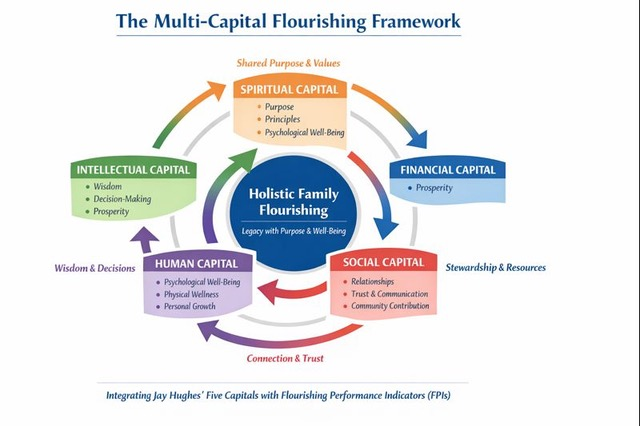
Image created by Anne White, Pure Goodness Consulting and used with permission.
Citation: Cale Dowell, Beniamin Pascut, and Matthew T. Lee. (2025). Flourishing Performance Indicators: A New Framework for Wealth and Legacy. A Special Report of the Institute for Global Flourishing at Baylor University.
Key Flourishing Performance Indicators, Flourishing Performance Indicators, and FPIs are trademarks of Cale Dowell, Beniamin Pascut, and Matthew T. Lee. This is a preprint prior to publication, not the final version.